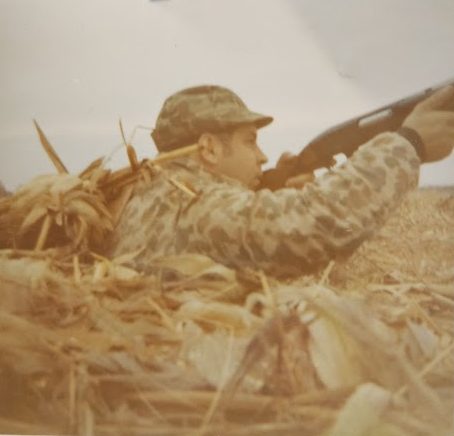
I found this place 44 years ago in mid-October. I wanted to hunt it that year, but I didn’t make it. I had other things planned that took me away from the Chesapeake Bay area that gunning season. For the last 44 seasons my plans always gravitate around this goose place.
You can’t find a place like that and miss it two hunting seasons in a row.
Here’s how I’m going to get there.
I’ll pack up the old Expedition in the driveway and head down Rt 50, over the Bay Bridge to Church Creek, down Egypt Rd. to the farm where the boat and decoys are. Hopefully, I’ll have someone with me that I really want to take along. Perhaps my younger brother and best friend Ken, or maybe Raymond, my eight year old grandson, and newest hunting and fishing partner, or Chris, a longtime friend, blue water fishing and hunting partner and his young son Will. When I found it, I was alone. You can’t go to a place like that by yourself; it has to be shared.
Then we’ll stow are gear in the cabin (really an old corn crib, but it does keep the cold and rain out) and put the decoys in the boat. You ought to know about her, briefly, right now, because we couldn’t do it comfortably without her. She’s my fishing and crabbing boat. She’s painted in camo and powdered by 15 horsepower Mercury on her stern. She’ll hold four- dozen goose and five-dozen duck decoys and draw about six inches of water. She’s made of aluminum and is a scrappy little craft. My brother named her “ALL FOWLED UP “.
After a restless sleep (it always happens the night before opening day) we’ll dress in our camo hunting clothes, fix some coffee and snacks and head for the boat.
We’ll load our guns, packs and junk into the boat; she’ll be full of leaves and mud and will smell musty from being idle for several weeks but we won’t notice it after the first few minutes. My partner will push her a few yards into the cut, a small channel, and deeper water and I’ll choke her motor and give it a quick pull. It won’t start; it never does on the first pull. One more hard pull and it fires. I’ll let her warm up a few minutes and then I’ll head her out of the cut into the river. When I reach the river I’ll head northeast straight to the point blind, just head for that low star that always hangs over the blind at night.
The blind has been there for many, many years. It sits about a mile from the headwaters of the Little Blackwater River. The river is close to five hundred yards across at this point. It’s is about four feet deep in front of the blind but can drop to eighteen inches if the wind is blowing hard from the northwest for a few days. The bottom is very soft and full of slit. A large marsh lies directly behind the blind. The river runs slowly through farmland full of harvested corn and soybeans on its way to the Chesapeake Bay. The Blackwater National Refuge is two miles due south down river, which hold tens of thousands of ducks and geese in the fall and winter. The blind started out as a fallen cedar tree. Over the years as the limbs became bare, we added a floor and three walls. As the marsh gave way and the blind stood about twenty feet from the shore, we added a long and narrow blind behind it for the boat. The pine and cedar covered blind now sits about thirty feet from the shore, right on a point facing east. It has great gunning no matter, which way the wind is blowing. We try not to shoot any fowl behind the blind that would fall in the marsh. The marsh is almost imposable to walk, very soft with deep boot-sucking mud. Because of the mud and silt there is not much food for the birds but it is a favorite resting spot for them. Also, with all the grain in the fields there are always birds moving up and down the river.
Once we are in front of the blind, I’ll kill the motor and switch over to the push pole slowly moving the boat into the wind and letting her drift back a few yards. At the same time my partner will place the goose decoys in two small groups with a hole about twenty-five yards between the two sets. The two groups will be fifteen yards directly in front of the blind. With the wind lightly blowing from the northwest the duck decoys, we’ll set on the other side of the point fifty feet from the nearest goose decoy.
We’ll check over the rig, making sure everything looks natural, before hiding the boat in back of the blind.
Tying the boat off on an old two by four jutting out from the back of the blind, we’ll climb and find our seats on the old worn bench. I’ll move to my spot on the right-hand side of the blind where I have sat all many, many hours throughout the years. Being a left-handed shooter, I have always favored this side of the bench. We’ll unpack our gunning bags, taking out our calls (if Scot is with me, he will have five are six), shells and binoculars. Then we’ll sat back and have a cup of hot coffee (if Raymond is with me, he’ll want something to eat) and wait till shooting time. I’ll look at my watch every two minutes even though we still have twenty-five minutes till legal shooting time.
In the faint grey light I can just barely see the outline of the marsh across the river. I can just make out seeing ducks crisscrossing it and the river. Mostly singles and doubles, but occasionally a small bunch. Every so often, I can hear a hen mallard up the river, and further down yet, or so it seems, Canada geese.
Shots echo far up the river and I check my watch once again, shooting time…another season starts. We crouch and wait, and then my partner sees a movement over the duck decoys. Two drake mallards’ approach, just a bit higher than my head. We wait until they are in front of the blind and my partner calls the shot. We pull up and swing with them as they pass twenty yards out front. We both fire at the same time, my bird on the right and his on the left, fall into the goose decoys. Two empty shells on the floor and two duck dead on the water. Giving ourselves high fives, we turn in time to see a half dozen green-wing teal buzz through the duck decoys. I watch until they are six specks disappearing down river.
Spooked by the shooting up and down the river, there are more ducks in the sky and out over the marsh. Mostly wood ducks, mallards, a few teal and gadwalls. Seven minutes later there are six more empty shells on the floor and three more ducks in our boat (two drake woodies and a hen gadwall).
Across the river the sun is starting to come up over the marsh. Faint orange over golden reeds, the decoys casting shadows on the near black water. White heavy clouds hang from the sky. You can smell rain in the air. I look out from the blind and wonder to myself how many times I have seen this over the years; a few hundred, maybe more? Still, no matter how many times it may be, I get Goosebumps from the sight.
The sound of three quick shots from my partners’ gun causes me to look up quickly in time to see two woodies fall from the sky and hit the water near the blind. “A nice shot if I say so myself”, he mutters and looks at me with a wide grin. It would have been if you had not fired three times for two ducks! Well, you know I did miss the third one he replies with the same wide grin. The sound of wings brings our guns to our shoulders as three more mallards come in low over the decoys. Again, I fire at the one on the right as my partner downs the two on the left. Ten’s the limit, I say. But my partner is already putting his duck calls away and taking out his numerous goose calls.
Fewer shots are now heard up and down the river. Ducks are still occasionally passing in front and to the right side of the blind. We both down another cup of hot coffee and wait for the geese to start moving in search of food.
Fifteen minutes pass and then a half hour and forty-five minutes more. We sit looking over the decoys moving in the light breeze that has just picked up a drizzle of rain is starting to fall now. It’s quiet now, very quiet. No sounds of shots or of calling (from both man and duck). Sometime soon, as it is with wild geese, a single bird will begin hooking, and then another, and a third, and four or five, and the entire flock will be honking and traveling up river.
One more sip of coffee. I hear the geese, or rather one goose, deliberate and resonant and close and unaware. Just across the marsh and down river six or seven hundred yards.
My partner calls, sounding like many geese wanting company. The goose answers, a long and sad call, saying “I’m lonely, can I rest with you all”. The air becomes full of goose noise. Four or five geese sound like twenty, twenty sound like an invading army. Geese are now everywhere, behind us, up river and in front. Shots start to ring out up and down the river. Far down the river we can see geese fall from the sky and then hear the muffle shots.
There is a tiny spider hanging from a thin silk thread in front of my face where I look out in front of the blind. Three or four times I mistake him for a goose flying in the distance. He has to go!
“On our right”, my partner whispers. Twenty-five geese have their wings locked and are gliding into the center of the decoys. Behind them are a dozen or so more, all with locked wings and feet hanging down. Now, my partner yells “TAKE THEM” and we stand up with guns to our shoulders I pick out a single in front and fire and he strikes the water with an incredible splash like a bowling ball dropped from an airplane. It no sooner hits the water and I fire again and repeat the scene.
I look into the decoys and see four dead geese; my partner has doubled also. WE have limited out with the first flock to decoy.
It’s raining harder now as we pick up the spread of decoys. The wind is a little cooler also. But we are warm and contented. Waterfowl hunting will do that to you
The End.
P/S I was told a few days ago that the farm was sold for 1.7 million dollars.